A pencil. A nearby view. Something to notice.
Free printable nature journal for kids
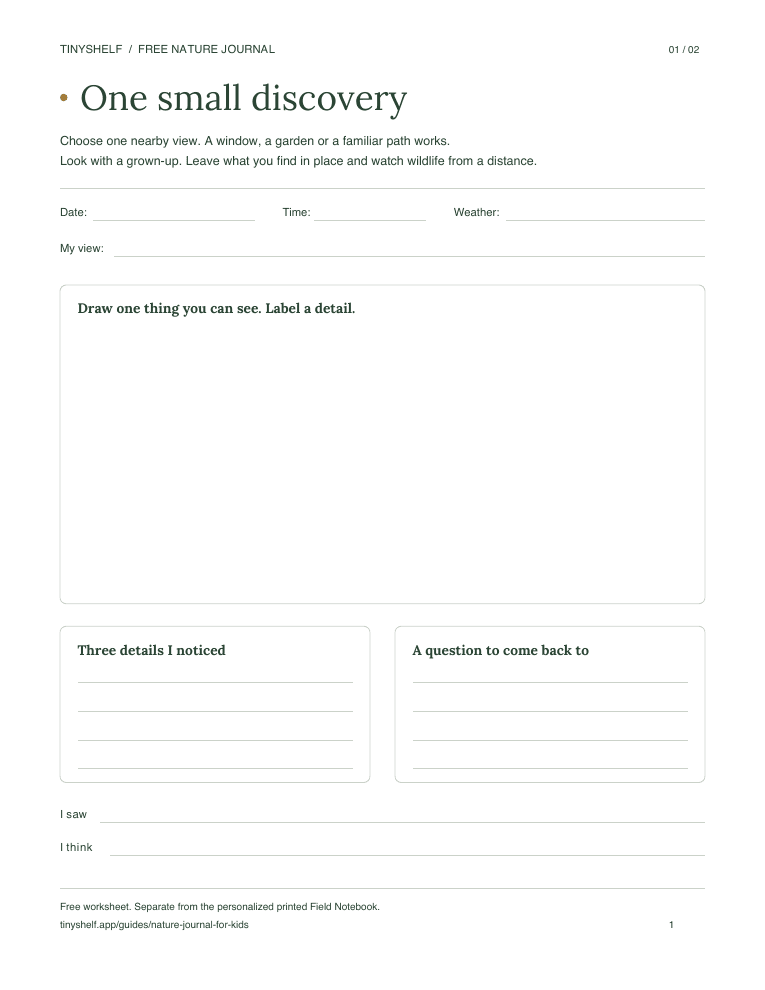
A child's nature journal can begin with one nearby view, a pencil and a few details they notice. Sketch what is there, record the date and weather, and leave a question to revisit. TinyShelf's free two-page printable gives you a first-observation sheet and a return-visit sheet. Use them on their own or alongside a nature book.
Download the free 2-page PDF ↓US Letter · Low-ink pages · No email, photo or purchase required
Original activity by TinyShelf
How do you start a nature journal with a child?
Print the sheets or copy the prompts into a notebook. Bring a pencil and choose a nearby view with a grown-up. Start with one thing the child notices; they can draw, dictate or write. There is no list of animals they must find and no need for a special outing.
Use the first sheet to record a view. Save the second for another day, then compare the two. Print extra copies for your family or class. These are original blank worksheets, not pages taken from the Field Atlas or its paid Field Notebook.
Three ways to use the pages
1. Stay with one small view
Choose a window, a familiar path or a place where you can sit with a grown-up. Spend a few quiet minutes looking at one small area. Record three details: a shape, a color, a movement or a sound. You can describe an animal without knowing its name. No sighting is required; clouds, shadows and plants count too.
2. Draw the evidence, then ask a question
Sketch one thing you can see and label a detail. Separate what you observed from what you think it might mean: a mark on a leaf is an observation; an idea about what made it is a question to investigate. Younger children can dictate their notes. Older children can add a count, a rough size comparison or a second sketch.
3. Return and compare
Visit the same view another day. Use the second sheet to compare your first sketch with today's view. Record one detail that stayed the same, one change and one new question. If you cannot return, compare two views from the same window. Keep the date and weather with each entry so you can read the notes together later.
Free spring observation sheet for kids
Watch one plant change
- With a grown-up, pick one plant near home. Sketch a twig or a small patch and look for buds, new leaves or open flowers.
- Come back in about a week. Draw the same part from the same spot. Record what you can see, even if the plant looks the same.
- Put your drawings side by side. Point to one detail you want to look at again on your next visit.
Download the free spring PDF ↓
One US Letter page for both visits. Bring a pencil and leave the plant where it grows. The USA National Phenology Network explains how repeated observations help people track seasonal changes.
Read about a discovery together
Hazel and Grandma spot a sea star. Hazel crouches on the dry rock beside Grandma and points, keeping a finger above the water.
The printed Atlas ships to the contiguous United States and Washington, DC.
Backyard bird checklist for kids
Print one sheet for each watch. Fill in the date and weather, then mark the clues you notice. There’s room to record which birds you saw and sketch one you want to look up.
- Size and shape: small and round, or long with a big tail
- Colors and markings: a stripe, a patch or a bright bill
- Movement: hopping, climbing, pecking or sitting still
- Location: on the ground, on a branch or by a building
Download the free bird checklist ↓
One US Letter page. Print copies for your family or class.
Try a five-minute winter window watch
- Choose one view from indoors, such as a branch, a fence or a patch of ground. Set a timer for five minutes.
- For each kind of bird, write down the most you see together. If one turns up first and later you see two together, write down two. You can label an unfamiliar bird by its markings.
- Watch the same view at about the same time on another day. Compare where the birds landed and what they were doing. If you see none, write down what you noticed while you waited.
For help naming a bird, start with the Cornell Lab’s bird identification guide. The tally method comes from Project FeederWatch. This short watch is a family activity you can record in your own notebook.
Can a nature journal become part of a gift?
Start with the free sheets and a pencil you already have. For a child who likes returning to their notes, an ordinary notebook leaves room for more visits. A reference book offers something different: pages to read and look things up in before or after an outing.
TinyShelf's Field Atlas is an optional personalized hardcover for ages 6–12, with 82 pages, seven American habitats and one chosen home-state chapter. The child is illustrated from a photo on selected surfaces. The optional 56-page printed Field Notebook is a separate paid add-on. Neither purchase is needed to use this worksheet.
Read the actual Atlas sample and current offer →The printed Atlas ships to the contiguous United States and Washington, DC. The downloadable worksheet can be used wherever you print it.
Compare nature gifts by age, budget and reading interest →Questions about the printable
What age is this printable nature journal for?
The prompts are written for roughly ages 6–12. At 6–8, a grown-up can read them aloud and write down the child's words. At 8–12, children can add their own labels, counts and questions.
Can we use it for homeschool nature study?
Yes. Print copies for your family or class and use the two visits as an observation activity. This is an optional resource, not a complete homeschool curriculum, assessment or claim of alignment to a school standard.
Do we need to buy the Atlas or upload a photo?
No. The PDF is free and needs no email address, account, child photo or book purchase. Print the US Letter pages at actual size, or use your printer's fit-to-page option for another paper size.
Is this the personalized Field Notebook?
No. This is a free two-page printable worksheet. The optional personalized Field Notebook sold with the Atlas is a separate 56-page printed softcover with the child's name and selected state. It is not included with this download.
Can we journal from indoors?
Yes. A window view works: record the light, weather, shapes, movement or sounds you can observe from there. Choose a comfortable, accessible place with a grown-up; you do not need to collect anything or approach wildlife.
More observation ideas
The National Park Service and New York's Department of Environmental Conservation publish further nature-journaling and family observation activities. TinyShelf wrote the worksheets and linked these resources for further reading.
Keep the activity comfortable and local. Watch wildlife from a distance and leave plants and natural objects in place.
Get the two printable pages ↓